Mud Circulation System
The mud circulation system moves fluid down the well and back to the surface in a continuous loop. In workover operations, this fluid (often called workover fluid, completion brine, or mud) serves several critical purposes: it carries cuttings, sand, and debris out of the well, controls downhole pressure, cools and lubricates tools, and keeps the wellbore stable during operations. Without proper circulation, even routine jobs like cleanouts or milling can quickly become difficult and dangerous.
Main Components
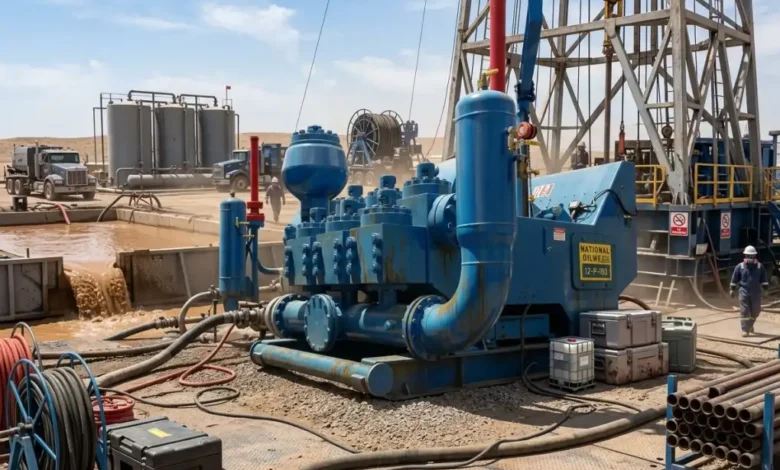
Mud Pump: The heart of the system. This high-pressure pump pushes fluid down through the work string at controlled rates and pressures. Most workover rigs use triplex pumps, which deliver steady flow with less pulsation.
Mud Tanks (Pits): Steel tanks that store the circulating fluid and give it time to settle before being pumped again. They are often divided into compartments for suction, settling, and mixing, and are usually portable on workover sites.
Standpipe and Rotary Hose: The standpipe carries high-pressure fluid up the mast, while the flexible rotary hose connects it to the swivel or power swivel, allowing the fluid to move with the traveling block.
Swivel or Power Swivel: The entry point where fluid passes from the stationary hose into the rotating string.
Return Line (Flow Line): Carries fluid coming back up the annulus (the space between the tubing and casing) to the surface equipment.
Solids Control Equipment: Shale shakers, desanders, desilters, and degassers remove cuttings, sand, and entrained gas so the fluid can be safely reused. Cleaner fluid means less wear on pumps and better well protection.
How the Circulation Works
Fluid is drawn from the tanks by the mud pump, pushed through the standpipe and hose, and pumped down the work string to the bottom of the well. It then travels back up the annulus, carrying debris with it, and returns through the flow line to the solids control equipment. After cleaning, it flows back to the tanks, and the cycle repeats.
Why It Matters
Proper circulation keeps the well clean, balances formation pressure, and protects downhole equipment. Monitoring fluid weight, viscosity, pump pressure, and returns helps operators detect problems early, such as lost circulation, a stuck pipe, or an unexpected influx of gas or oil. Regular pump maintenance and fluid testing are essential for safe, efficient operations.